Case study · Competitive win

Work Playback: from a gap in my competitor sheet to a revenue-generating add-on

Academics investigating contract cheating had to email us and wait while someone manually recorded a video. I found the gap in my own competitor research, pitched it, shipped it — and it became a billable module that helped convert a pilot into an enterprise contract.

My role
Product Manager — research, pitch, delivery
Team
One engineer, Support & Commercial
Adoption
4 of 12 enterprise tenants
Commercial outcome
Pilot converted to enterprise
The problem

Integrity investigations ran on a manual, human-powered workflow

Cadmus could reconstruct exactly how a piece of work was written — a continuous, snapshot-to-snapshot replay.

The capability existed

Powerful evidence in a contract-cheating case.

Academics couldn't reach it

No surface. Every request went through a chain of people.

Before

Request, wait, receive a file

6hand-offs
  • Academic suspects contract cheating and emails the support team.
  • Support opens an internal tool and locates the work.
  • Environment, work ID and tenant are entered by hand.
  • The timeline is recorded manually as a video file.
  • The download is renamed, then uploaded to shared storage.
  • A link is emailed back to the academic.
After

Open the class list and watch it

1click
  • The academic opens the playback directly from the class list, in the same place they already manage the cohort.

No ticket, no queue, no waiting on someone else's availability — and no internal staff time consumed per investigation.
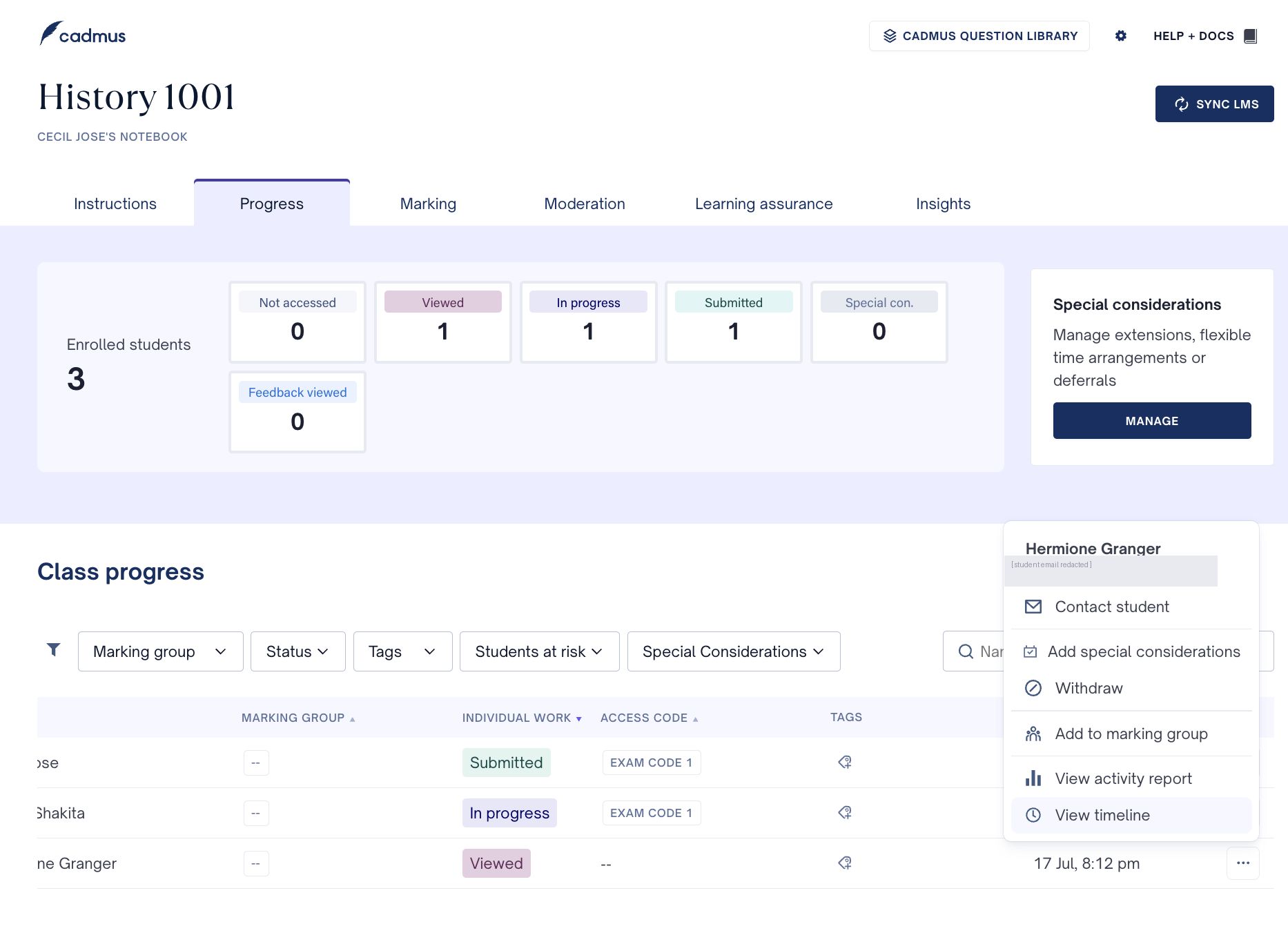
Cadmus class progress page with the per-student menu open, showing View timeline
1 2 3
1View timeline — the entry point the pitch delivered. One click, in the row of the student being investigated.
2The academic is already here managing their cohort — no context switch, no ticket.
3Sits alongside Marking, Moderation and Learning assurance, so it reads as part of the integrity workflow rather than a bolt-on.

Sandbox tenant with test students; student contact detail redacted.

Obvious

An academic with a time-sensitive integrity concern was blocked on someone else's inbox.

Less obvious

Every investigation consumed staff time, so cost scaled with how much customers valued it — exactly the wrong shape.

Bundled scope

Timelines became recordable for every assessment, not just where the setting was on. Without it, self-service would have silently failed on much of the work academics wanted to examine.
Where the idea came from

My own competitor matrix flagged it before any customer did

In the comparison I maintain — 40+ products, quarterly — submission-replay was a row where a competitor had a tick and we didn't.

Turnitin Clarity

Shipped writing-process visibility

A competitor already surfaced how a submission was constructed over time, as a product surface academics could reach themselves.

Cadmus, at the time

The capability existed — the access didn't

More detail than a text-comparison tool — but not exposed to the people who needed it, so it never counted in an evaluation.

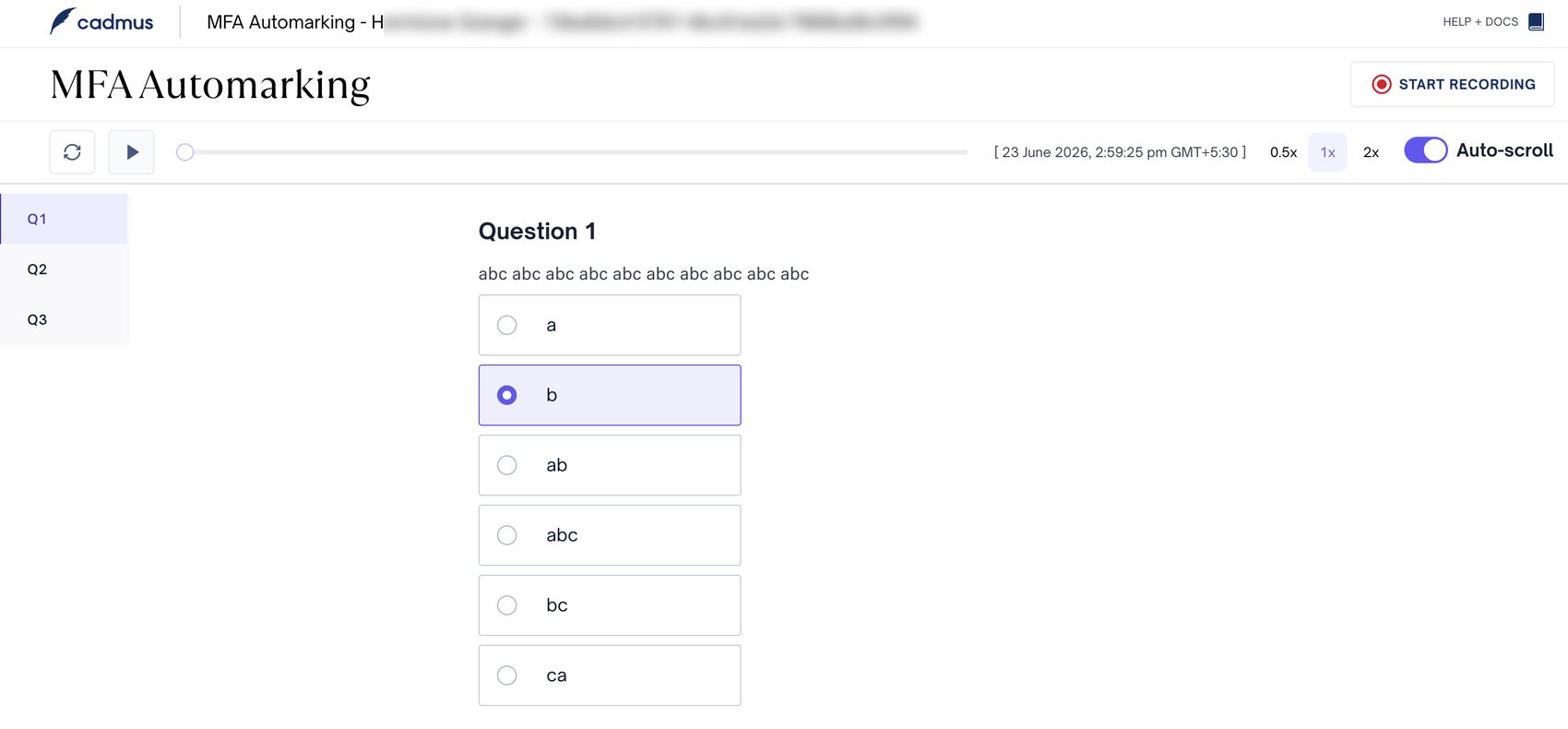
Work Playback reconstructing a student submission, with scrubber, timestamp and playback speed controls
1 2 3 4
1Timestamps — the fix from my scoping miss. Without these you can't correlate the replay against an activity report, which is the whole job in a misconduct case.
2Scrubber and play control — the academic drives the reconstruction themselves rather than watching a rendered file someone emailed them.
3Playback speed and auto-scroll, so a long submission can be reviewed at 2× or slowed at the moment of interest.
4Per-question navigation — jump straight to the answer under suspicion.

Sandbox exam with placeholder question content; internal work identifier redacted.

The reframe

Not a missing capability — a missing surface. We were losing evaluations on a feature we already had, because it lived in an internal tool. We weren't building submission replay; we were exposing it — which is what made it cheap enough to justify.

How it happened

Research → request → pitch → ship → revenue

The one project in my portfolio that closes the full loop from competitive research to money on the table.

01
Gap identified

Quarterly refresh of my competitor matrix surfaced submission-replay as a row where Turnitin Clarity led and Cadmus was blank.

02
Sales pulled it forward

The commercial team recognised it as a live differentiator in deals and asked for prioritisation.

03
I shaped the pitch

Timeline access straight from the class list, plus recording enabled for all assessments regardless of tenant setting.

04
Built & hardened

Delivered with one engineer, released behind a flag, then fixed what real first use exposed.

05
Sold as an add-on

Packaged as a billable module rather than given away in the base product.

Flag = pricing

The flag was commercial, not technical. It let the capability be packaged and priced rather than absorbed into the base tier — how a support workflow became a revenue line.

Impact

Adoption, and a contract

4 / 12
enterprise tenants have Work Playback enabled. Heaviest use sits with Massey University and the University of Adelaide, both running it as a standing part of their academic integrity process.
The outcome that mattered

Massey University converted from pilot to a full enterprise contract

Work Playback was part of what took Massey from pilot to enterprise. A gap I found in a spreadsheet became a feature that helped close a contract — the clearest line I can draw between product research and commercial outcome.

Shipped & monetised Support workload per investigation removed Competitive parity closed on a key evaluation row
Reflection

What I got wrong, and what I'd repeat

The scoping miss

The first release shipped without timestamps — missed in requirements, survived QA, caught by Support within days.

Why it mattered

For an integrity investigation timestamps aren't decoration — they're how you correlate the replay against an activity report.

Fixed fast, but it shouldn't have reached users: I wrote the spec from the shape of the feature rather than the job the evidence has to do.

What I'd repeat

Treating the competitor matrix as a live instrument rather than a document. No customer request, no roadmap workshop — a quarterly refresh, spotted early enough that Sales could use it while deals were open. Research only pays off if someone reads it on a schedule.