Case study · Marking & rubrics

Zero Point Rubrics: letting academics grade holistically without fighting the rubric

Humanities academics judge an essay as a whole; every Cadmus rubric format forced criterion-by-criterion scoring anyway. I shaped a fourth format that decouples the rubric from the score entirely.

My role
Product Manager — discovery, shaping, pitch, design direction
Timeline
Mar → Jul 2026
Team
Design, Engineering, UK Customer Success
Outcome
Fourth rubric format shaped, specced & designed
The problem

Three rubric formats, one shared assumption

Three formats, different maths, same requirement: a number against every criterion, and a grade derived from those numbers.

Rubric format Criterion-level score
Weighted percentagesEach criterion carries a % of the total
● Mandatory
Points rangeEach level spans a low–high point band
● Mandatory
Absolute pointsEach level is a fixed point value
● Mandatory
Qualitative / zero-pointCriteria are descriptive; the marker enters one final score
✓ Optional
Numerically-marked exam

The assumption is invisible. Parts genuinely add up to a total.

Essay, diary, source analysis

It fights the marker. They already know the grade — then have to reverse-engineer per-criterion numbers to reach it.

The real gap

Not a missing feature — a missing assessment philosophy. Every format assumed a grade is built up from parts. Whole disciplines assume the opposite.

Discovery

Two institutions, two different reasons for the same ask

Raised by the UK team all year. Rather than build from the ticket I ran calls with academics at two institutions — and they wanted it for genuinely different reasons.

Programme lead · University of Glasgow

"Even when the argument is clear and coherent, I still have to mark against the criteria."

  • Marks predominantly humanities and social sciences — essays, reflective diaries, source analysis, formulation tasks.
  • Glasgow marks against primary bands on a 22-point scale, not criterion arithmetic.
  • Wants the rubric to communicate feedback against learning outcomes, and the grade to be entered separately.
What this told me: the rubric's job here is communication, not calculation. Scoring it is the accident, not the purpose.
Faculty · James Sprunt Community College

"Scaffolding matters — students need a grade at each stage as a buy-in."

  • Runs continuous assessment: provisional feedback carries grades, finals are numerically assessed.
  • Wants different rubrics for different phases — a process rubric for drafts, a learning-outcome rubric for the final.
  • Confirmed the zero-point format helps, but flagged that phase-specific rubrics are the deeper need.
What this told me: a real adjacent problem — and one I deliberately kept out of scope rather than let it inflate the bet.
Boundary

Easy to absorb into a pitch, hard to ship. Naming it as a separate problem kept this bet small enough to land.

Key decision

A new format, not a zero on the old one

The call I had to defend

Should a scoreless rubric be a new format, or just the existing rubric with weightings set to zero?

Rubric weighting was already in flight. A 0% weighting would have behaved almost like a qualitative rubric for a fraction of the effort. I argued against it.

Option A · rejected
Allow 0% weighting in the existing rubric

Cheap and fast — but it overloads a field that already means something, leaves scoring machinery visible in a rubric with no scores, and confuses weighting for everyone using it properly.

VS
Option B · chosen
A distinct fourth rubric format

More work, but the format states its own intent. Scoring inputs are removed rather than zeroed, the existing three formats are untouched, and a marker can't mistake what they've opened.

Reasoning

Zero isn't the same as absent. 0% is a scoring decision; qualitative is the absence of scoring as a concept. Encoding the second as a special case of the first breaks the existing flow to protect a shortcut.

In scope must have

  • New format option in the builder — weighting and max-score inputs removed from criteria rows; point ranges removed from scale items; criteria and levels become label plus description only.
  • Optional level selection while marking — a marker may select a level per criterion and comment against it, but is not required to.
  • A standalone final score input in the marking view, pre-populated with the correct total from settings.
  • Grade passback unchanged — the final score flows to the gradebook exactly as it does today.
  • Students see the rubric and their level, plus written feedback and the final grade — never a per-criterion score.

Explicitly out not this bet

  • Replacing the existing three formats — this is additive, not a migration.
  • Auto-calculating the final score from criteria selections. The rubric is descriptive; the human decides the number.
  • Multi-phase / multi-rubric support — the draft-versus-final rubric need surfaced in discovery. Real, but a separate problem.
  • Changing the student-facing rubric display. Students keep viewing and downloading rubrics exactly as before.
Why write them

Three of the four are things a reviewer would otherwise have reasonably assumed were included. Writing exclusions down was as valuable as writing requirements.

The shape

What changes, for whom

One format, three surfaces.

Constraint

The “score out of” value has to come from a different place depending on the assessment type.
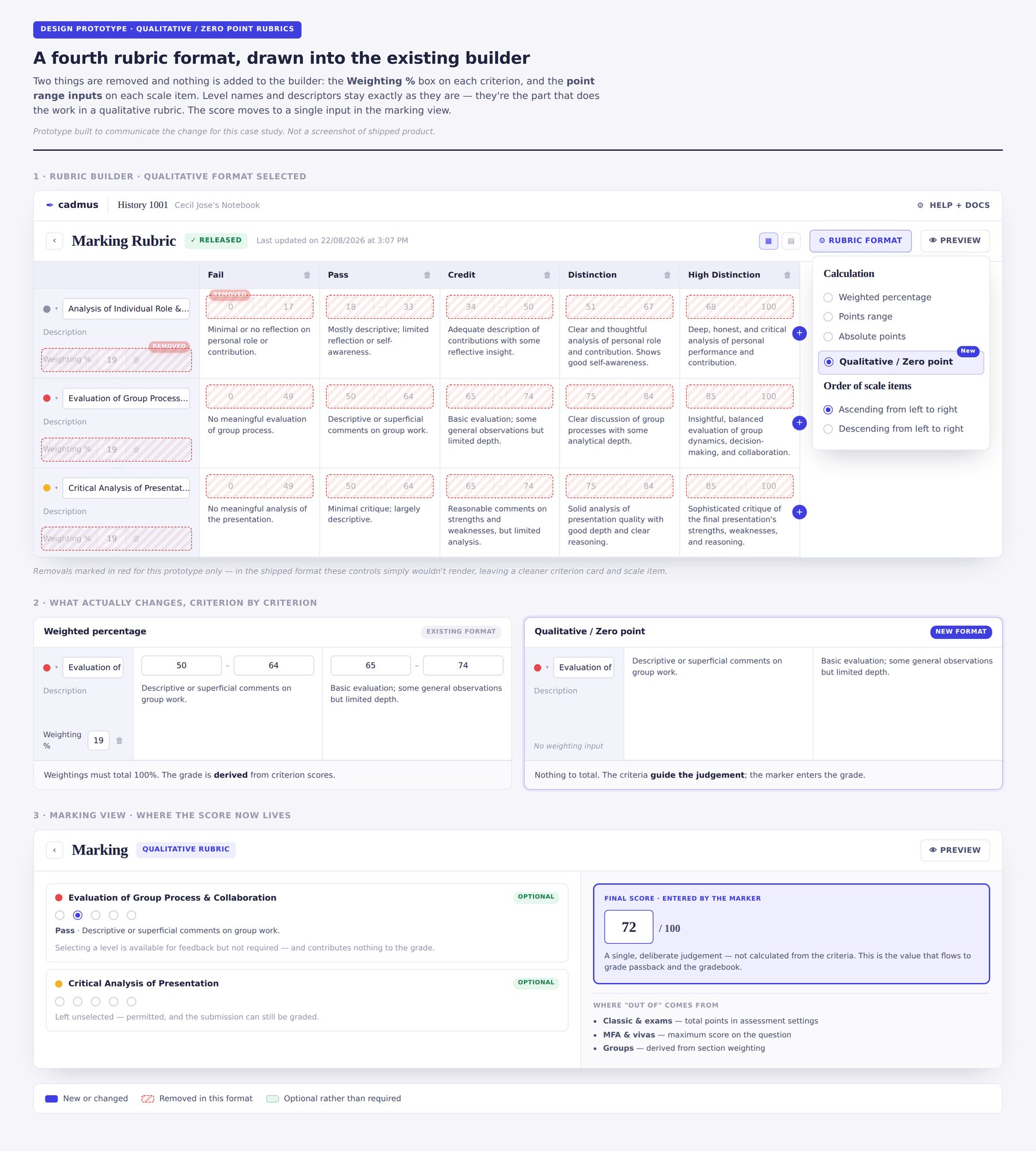
Design prototype showing the qualitative rubric format: weighting boxes and scale-item point values removed, with a standalone final score input in the marking view

Design prototype, not shipped product — weighted beside qualitative, the two removals marked, and where the score moves to.

Open the full prototype →
Teacher · rubric builder

Build a rubric that can't be scored

  • Pick "qualitative" as the format.
  • Weighting and max-score fields disappear from criteria.
  • Scale items lose their point ranges.
  • Name and description validation stays exactly as-is.
Marker · marking view

Judge holistically, enter one number

  • Read criteria descriptions to calibrate.
  • Optionally select a level and comment per criterion.
  • Enter the final score in a standalone field.
  • Total auto-populates: from settings for Classic and exams, per-question max for MFA and vivas, section weighting for group work.
Student · feedback view

See the judgment, not the arithmetic

  • Rubric criteria and the level the marker selected.
  • All written feedback.
  • The final grade.
  • No aggregated or per-criterion score, because none exists.
How the market handles it

Scores hidden, not removed

Canvas, Moodle and Turnitin aggregate criterion scores into a grade. A “no points” mode usually hides the display while the scoring model stays intact.

How we approached it

Scoring genuinely decoupled

Scoring machinery absent from the criteria rather than concealed, and the final grade an independent, deliberate input by the marker.

Status & reflection

Where it stands

Discovery, shaping, the requirements spec and the design prototypes are complete across all four assessment types. Awaiting a build slot.

Discovery complete — 2 institutions Pitch shaped & requirements specced Design prototypes complete Scoped across Classic, MFA, Vivas & Groups Success metrics still to define

What I'd do differently

I shaped requirements before defining how we'd know it worked — the success-metrics section is still empty. For an additive format “did anyone choose it?” is measurable from day one. With designs done, it's the one gap left before build.

What I'd keep

Refusing the cheap path. Zero-weighting would have shipped sooner and quietly degraded rubrics for every teacher already using weightings correctly. Writing down the four things I deliberately wasn't building kept the bet reviewable.