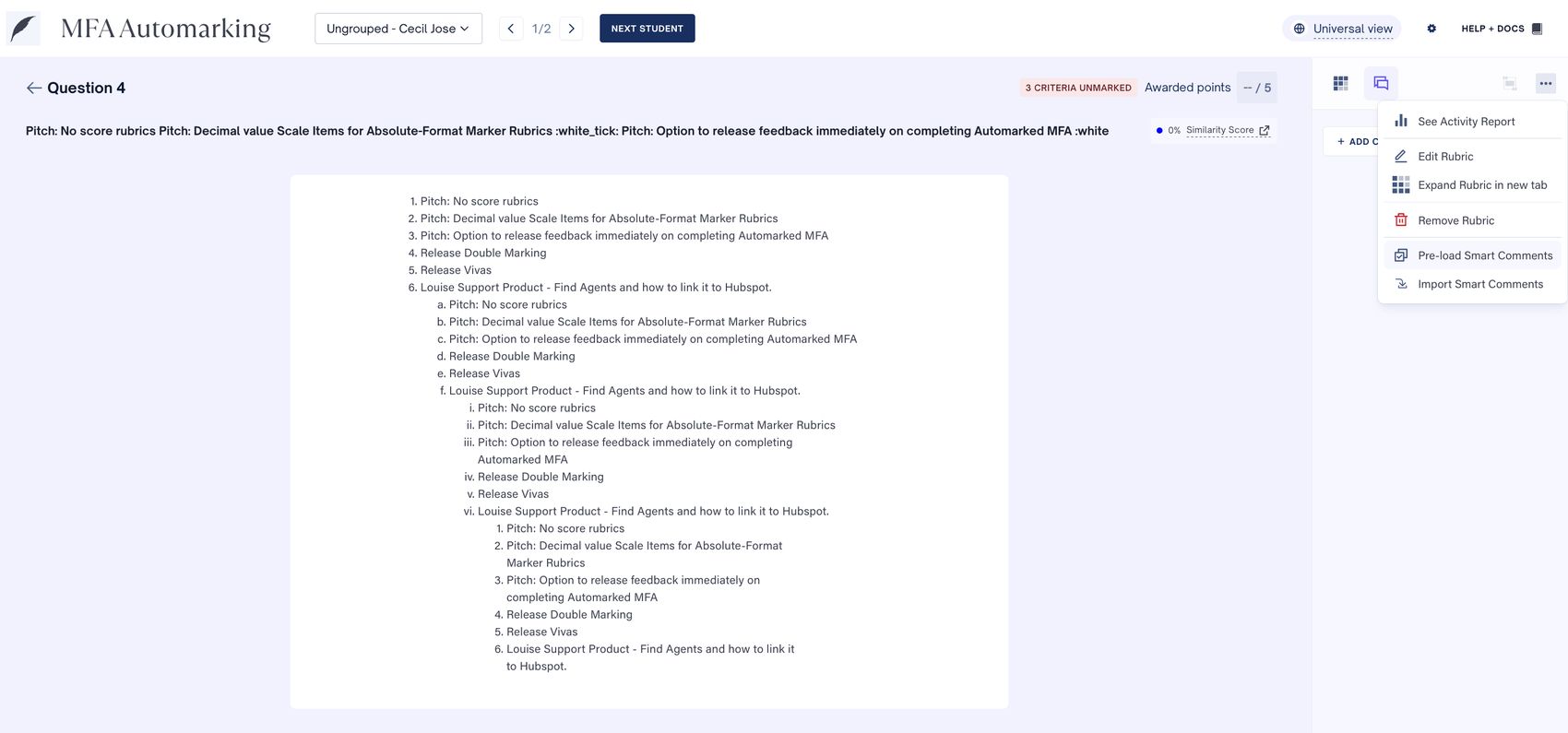
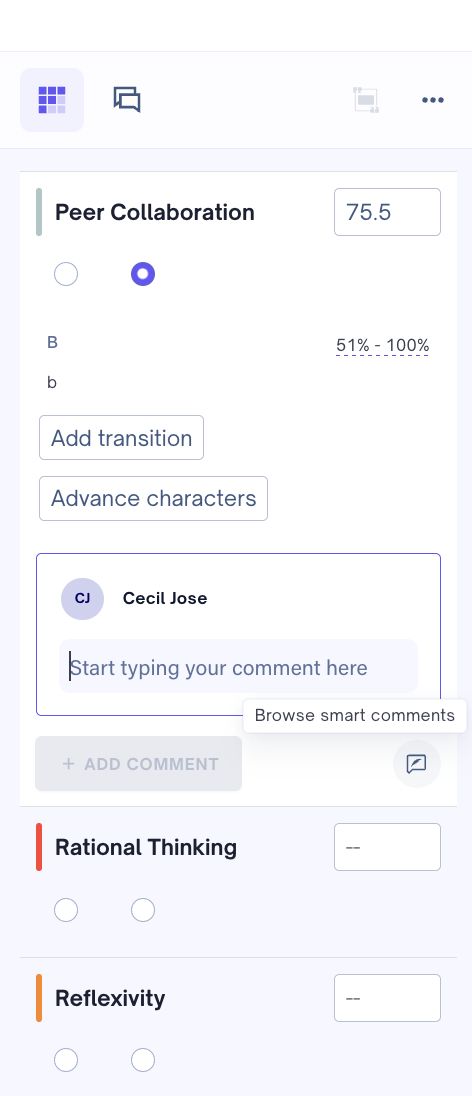
I marked with the competitor's version before designing ours
Parity meant knowing exactly what academics were being asked to give up. I marked with QuickMarks the way they would — which is where the opening showed up.
Curated sets, managed separately from marking
- Reusable comments live in QuickMark sets — curated collections built and managed as their own artefact.
- The set is built ahead of the cohort, as a separate task from marking it.
- The model assumes you know your comments before you meet the cohort.
- The practical result: the comment you need mid-script often isn't in the set, so you type it and move on.
Any comment, promoted in-flow, scoped to rubric & score
- A marker clicks Add to Smart Comments on a comment they've just written, without leaving the script.
- No upfront curation step. Reusable comments accumulate from feedback the marker was writing anyway.
- Reuse is scoped to the rubric and score the comment was written against, so suggestions arrive in context.
- A marker can also mark comments for reuse deliberately, or remove one — so the set stays theirs to control.
Matching QuickMark sets alone would have unblocked the three sales — and fit comfortably inside the appetite. Which is why what came next was a choice, not a necessity.
Two workarounds that made ours better than the thing we were matching
Two frictions became obvious, and neither needed a bigger project — just a different placement. Both went into the pitch as additions to the parity scope:
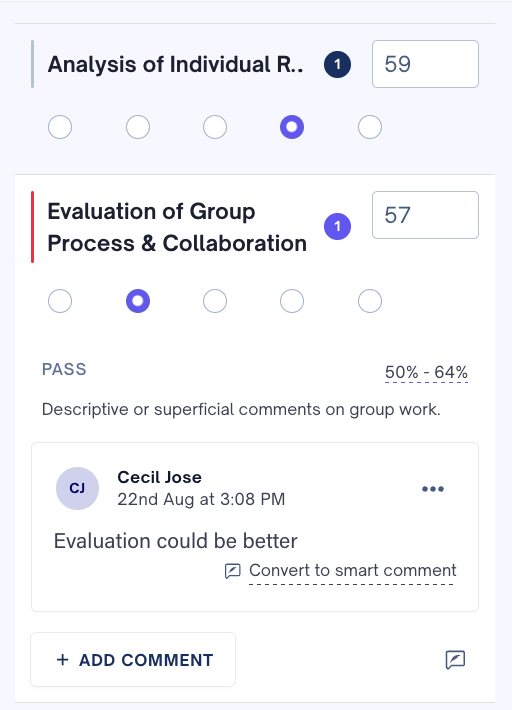
1 — Convert a comment into a smart comment while marking. The comment a marker needs is the one they just wrote, not one predicted a week earlier. Reuse costs nothing to set up.
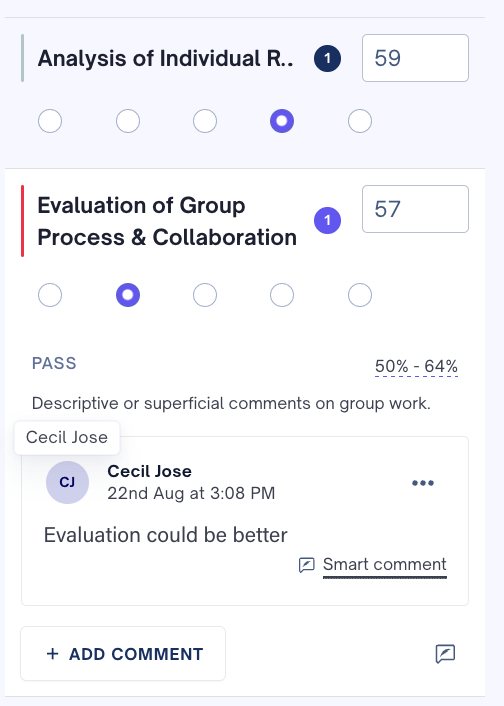
2 — Attach it to the rubric criterion it was written against. A flat pool gets worse as it grows. Tying each to its criterion and score band means suggestions arrive pre-filtered.
Neither was in the brief. Both came from using the competitor's product rather than reading its feature list — the difference between “we have this too” and “ours is easier”.
1 · The comment a marker just wrote
 1
1
2 · Now reusable, still in context
 2
2
Sandbox tenant with a test rubric.